
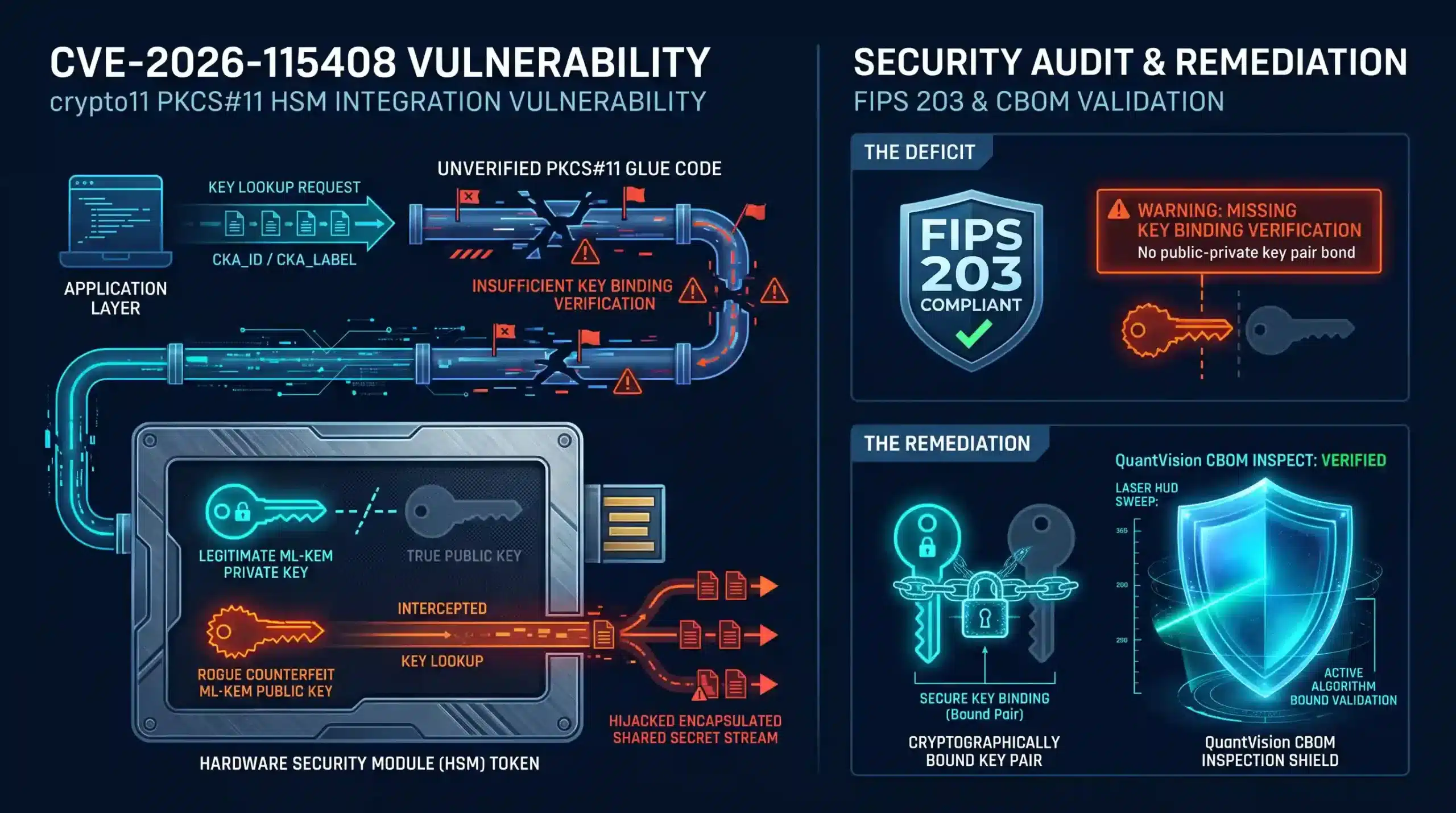
Your ML-KEM rollout can be fully FIPS 203-compliant and still leak every shared secret it generates. The bug isn’t in the lattice math — it’s in the plumbing underneath it.
WHAT SHIPPED: Eclipse Keypont’s crypto11, a Go PKCS#11 binding widely used to connect applications (including Kubernetes KMS plugins) to HSMs, added native ML-KEM support in its v2 pre-releases. CVE-2026-115408 (CVSS 5.5, disclosed Oct. 27) hit versions 2.0.0-rc3 through rc8.
THE FLAW: The key-pair lookup functions matched a public ML-KEM key to its private counterpart by CKA_ID/CKA_LABEL — without ever confirming the two actually belonged together. If the private key had no ID set, the lookup silently fell back to returning the first ML-KEM public key found on the token.
THE IMPACT: Anyone who can open an unauthenticated session on the token can plant a counterfeit public key carrying the victim’s label, and the application will happily encapsulate shared secrets against it — handing an attacker everything derived from that key. Fixed in rc9.
THE LESSON: “FIPS 203-compliant” describes the algorithm, not the glue code wiring it to your HSM. As vendors race to retrofit ML-KEM into PKCS#11 libraries, KMS plugins, and key managers, expect more bugs like this one — in object lookup, attribute handling, and session logic, not in the math NIST already vetted.
Bottom line: standardized crypto doesn’t make your integration trustworthy. Every library in the path from application to HSM needs its own scrutiny — key binding, session isolation, attribute verification — independent of whether the underlying primitive is sound.
How is your team auditing the PKCS#11/HSM glue code behind your PQC rollout — or are you assuming the FIPS label covers it?
#PostQuantumCryptography #PQC #Cybersecurity #CryptoAgility #CISO #QuantumSafe #InfoSec #FIPS140 #HSM #AppSec