

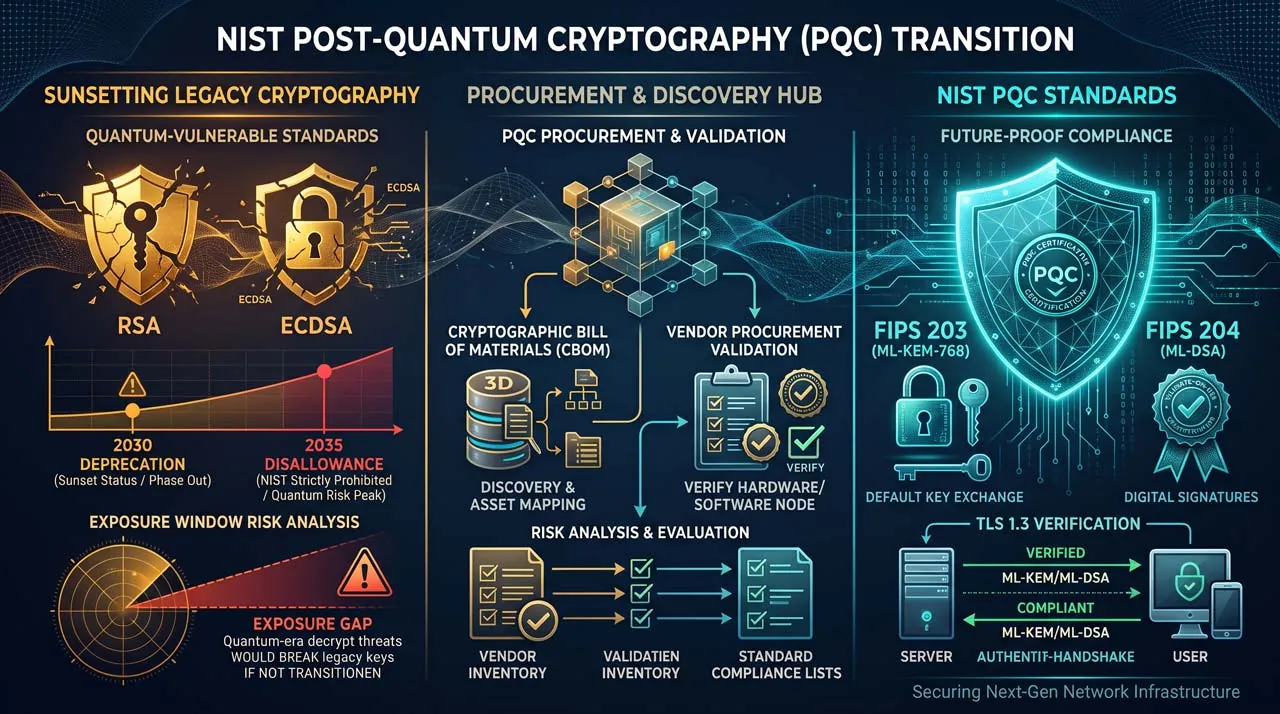
NIST just quietly reset the PQC conversation: this isn’t a crypto team problem anymore, it’s a procurement problem.
A new NIST transition report highlighted this week spells out what “post-quantum ready” should actually mean when you’re buying software, hardware, or cloud services — and the fine print matters more than the headline.
ML-KEM-768 is the default, not ML-KEM-1024. NIST recommends ML-KEM-768 (FIPS 203) as the standard key-establishment parameter set for most use cases, balancing security margin against performance cost. Save the heavier 1024 tier for where it’s actually warranted.
Hybrid is a bridge, not a destination. Classical+PQC hybrid schemes are explicitly framed as a temporary step, not the end state — architect for a second migration to PQC-only, don’t build around hybrid being permanent.
Your exposure window is already ticking. NIST’s own math: data needing 15 years of confidentiality plus a 5-year migration lag equals a 20-year exposure horizon. If that describes your data, harvest-now-decrypt-later isn’t a 2030 problem — it’s a today problem.
“TLS 1.3 supported” is not the same as protected. Federal agencies must support TLS 1.3 by Jan 2, 2030, but protocol support alone proves nothing. A vendor’s “hybrid” toggle might mean a real combined handshake, or just a choice between classical and PQC. Ask which.
Bottom line: the hard deadlines (2030 key establishment, 2031 signatures, 2035 full disallowance) are federal, but the underlying math — exposure windows, vendor claims, algorithm-to-service mapping — applies to every CISO buying anything with a cryptographic dependency. You can’t negotiate protection you haven’t verified.
How is your organization validating vendor PQC claims before renewal — asking, testing, or just trusting the marketing page?
This is exactly the blind spot QuantVision’s CBOM discovery is built to close: mapping which algorithms actually protect which services, including the ones still leaning on vulnerable key establishment underneath a layer of AES.
#PostQuantumCryptography #PQC #CISO #CryptoAgility #NIST #QuantumSafe #Cybersecurity #RiskManagement #SupplyChainSecurity #TechLeadership