

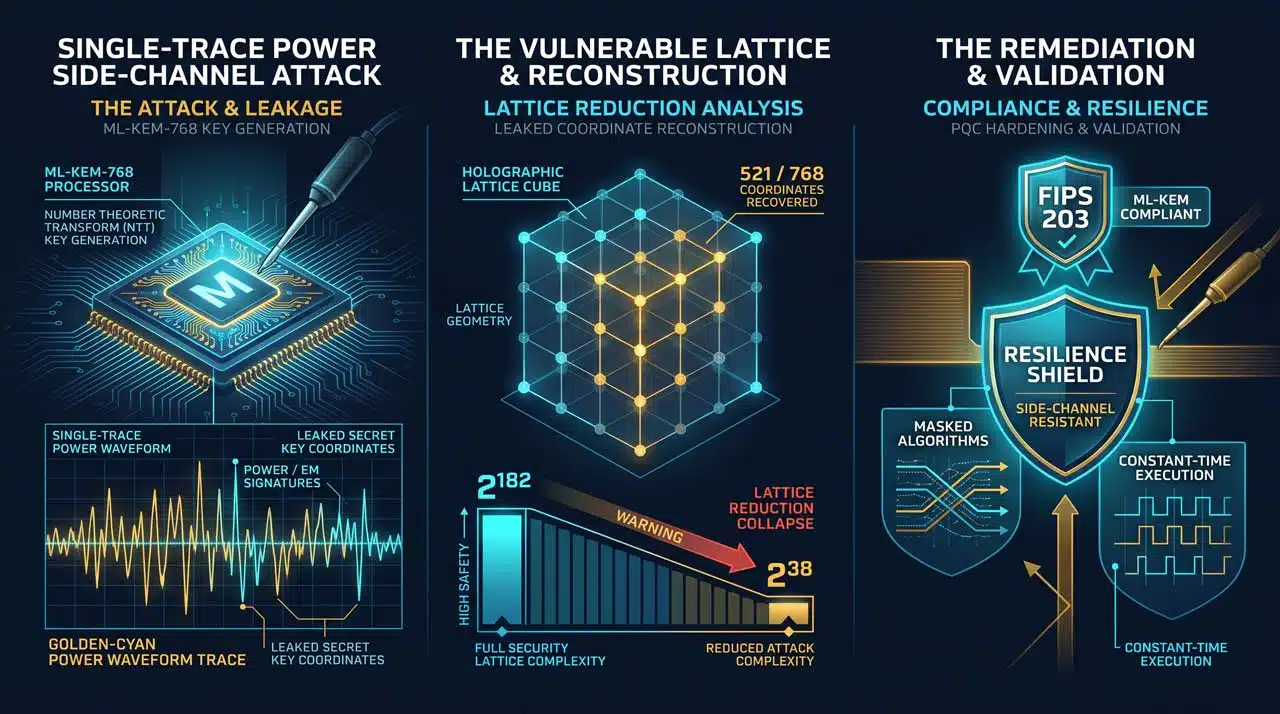
Your ML-KEM private key doesn’t need a breached server to leak — a single power trace captured during key generation is enough.
That’s the result Radboud University researcher Vahid Jahandideh presented this week (Nov 15–19) at ACTIVE ’26, an ACM CCS workshop on assisted cryptographic verification in The Hague.
The target: ML-KEM (FIPS 203) key generation samples a secret vector during the Number Theoretic Transform step. A profiled single-trace attack follows each coefficient to its most informative point in that one trace.
The number that matters: Combined with lattice reduction, the leaked trace pins down 521 of ML-KEM-768’s 768 secret coordinates exactly. That collapses the required BKZ block size from 624 to 129 — estimated security falls from roughly 2^182 bits to about 2^38 bits in the core-SVP model. One trace, one key.
What it isn’t: This is not a break of Module-LWE or the ML-KEM specification. It’s an implementation weakness — it requires physical or co-located access to power/EM emissions during key generation, the same category that produced KyberSlash and other timing bugs before it.
Bottom line: “FIPS 203-compliant” and “side-channel resistant” are two different claims. Masked, constant-time key generation has to be verified per chip and per library, not assumed from the algorithm’s paper security level — especially anywhere key generation happens on hardware an attacker can get near.
That’s why QuantVision’s CBOM discovery goes beyond algorithm names to map exact library versions and hardware cryptographic modules across your fleet — so unmasked or side-channel-exposed ML-KEM implementations don’t hide behind a “FIPS 203-compliant” label.
Is side-channel validation part of your PQC vendor evaluation, or does FIPS 203 compliance stop the checklist?
#PostQuantumCryptography #PQC #MLKEM #SideChannelAttack #Cybersecurity #CISO #CryptoAgility #FIPS203 #QuantumSafe #InfoSec