

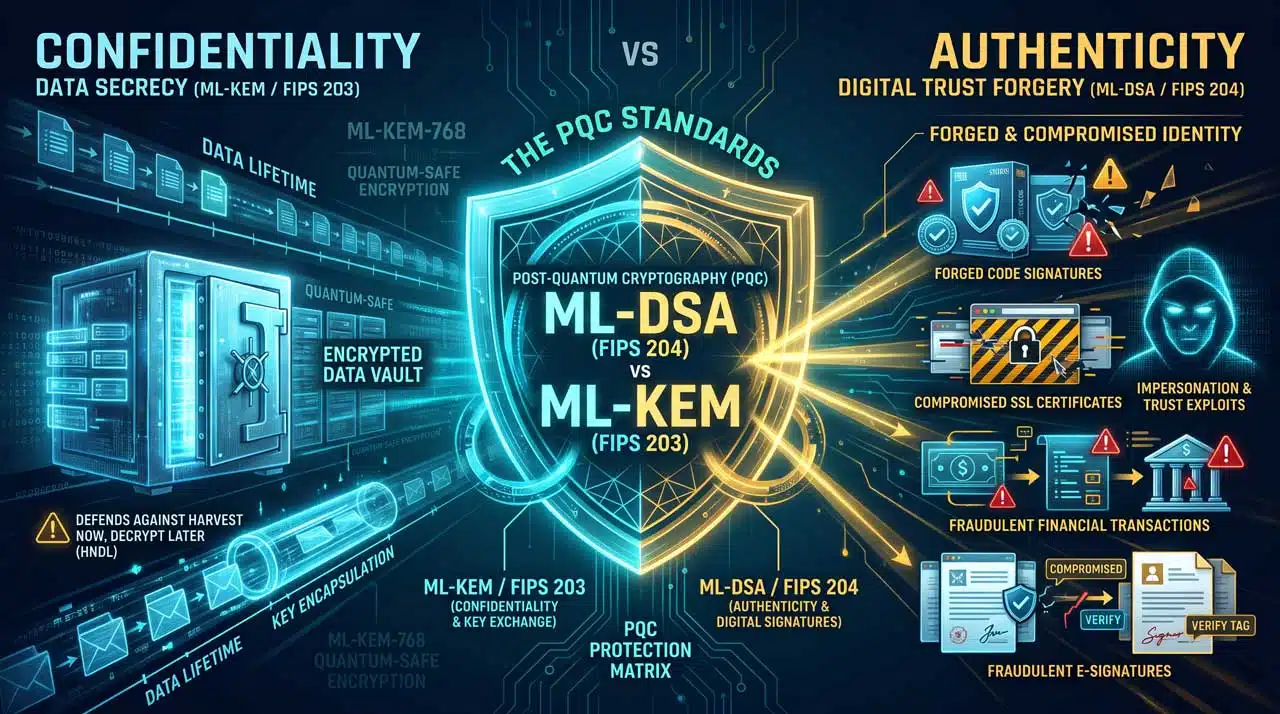
Most PQC risk conversations start with one question: “How long does our data need to stay secret?”
That framing misses half the threat. A Nov. 3 SecureWorld piece by security researcher Ian Schneller makes a sharp point: harvest-now-decrypt-later (HNDL) only scares organizations sitting on decades-long secrets. Retail, media, and food-service leaders often wave off PQC urgency because their data’s shelf life is weeks, not years. But quantum-capable adversaries don’t just break confidentiality — they break trust, and trust doesn’t expire with a sales cycle.
Four places where “trust” is the asset, not secrecy:
Software supply chain. Forge a code-signing key and an attacker pushes malicious updates your systems trust by default — regardless of how short-lived your data is.
Certificates & access control. Cloud/API authorization runs on certificates built from signature algorithms like ML-DSA (FIPS 204). Break the signature, and impersonation follows.
Contracts & non-repudiation. An e-signed agreement’s validity depends on the signature staying unforgeable for the life of the contract, not just the negotiation.
Financial transaction authorization. A forged signature on a payment rail isn’t a stale secret — it’s a fraudulent wire transfer, today.
This mirrors what NSA flagged Oct. 1 as “trust now, exploit later” — distinct from HNDL, and harder to wave off with a data-retention argument.
Bottom Line: If your PQC assessment stops at data sensitivity, you’re missing where signing keys and certificates sit across your stack. Qubit Guard’s QuantVision discovers crypto by function — KEM vs. signature — across network traffic, code repos, build pipelines, and PKI, so authentication risk doesn’t hide behind a retention policy.
How is your organization scoping PQC risk: by data sensitivity, or by what breaks if a signature gets forged?
#PostQuantumCryptography #PQC #Cybersecurity #CISO #DigitalTrust #CryptoAgility #NIST #CodeSigning #SupplyChainSecurity #QuantumSafe