

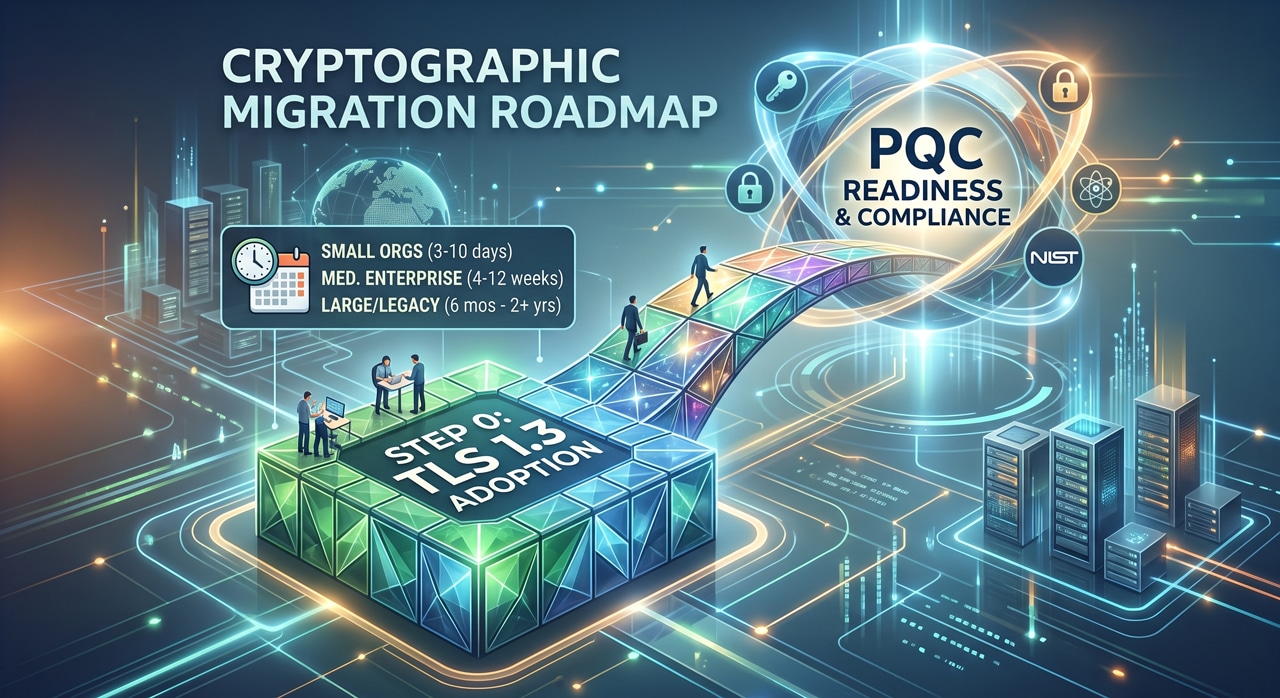
If you are leading cybersecurity or post-quantum readiness efforts, this isn’t just a best practice—it is the foundational prerequisite for quantum resilience.
As organizations gear up for Post-Quantum Cryptography (PQC) migration, many overlook a critical dependency: your network layer must support TLS 1.3 before you can deploy NIST-standardized PQC algorithms like ML-KEM.
Here is why upgrading to TLS 1.3 is step zero for PQC readiness:
- Native Hybrid Key Exchange Architecture TLS 1.3 was designed with a key-exchange protocol structure that natively supports hybrid key negotiation (combining classical algorithms like X25519 with PQC algorithms). Legacy protocols like TLS 1.2 lack this architecture, making PQC integration non-standard, fragile, and inefficient.
- Elimination of Deprecated, Vulnerable Ciphers TLS 1.3 strips away outdated cryptographic primitives and vulnerable cipher modes (such as CBC mode and static RSA key exchange). By forcing perfect forward secrecy (PFS) by default, it cleans up technical debt before adding complex PQC algorithms into the handshake.
- Handshake Efficiency and Performance PQC key exchanges and public keys carry significantly larger parameter sizes than classical ECC or RSA. TLS 1.3 optimizes the handshake to a single round-trip (1-RTT), which helps offset the latency and packet overhead introduced by quantum-safe keys.
Realistic Migration Timelines:
How long does moving to TLS 1.3 actually take? The technical setting takes minutes, but client discovery and compatibility remediation consume months:
| Environment Profile | Estimated Timeline | Typical Scenarios & Scope |
| Small / Cloud-Native | 3 to 10 business days | Modern web stacks hosted on platforms like AWS, GCP, or Azure (CDN/Load Balancer updates). |
| Medium Enterprise | 4 to 12 weeks | Hybrid cloud infrastructure, multiple web apps, and internal APIs requiring phased rollouts. |
| Large / Legacy-Heavy / Regulated | 6 months to 2+ years | Banking, healthcare, or defense with legacy mainframes, IoT devices, or outdated client SDKs. |
The Bottom Line: If your organization waits for final PQC implementation mandates before upgrading your TLS layer, you will face an immediate architectural bottleneck. Upgrading to TLS 1.3 isn’t just routine infrastructure hygiene—it is the runway for post-quantum security.
#Cybersecurity #PostQuantumCryptography #PQC #TLS13 #Cryptography #InfoSec #QuantumSecurity #RiskManagement