

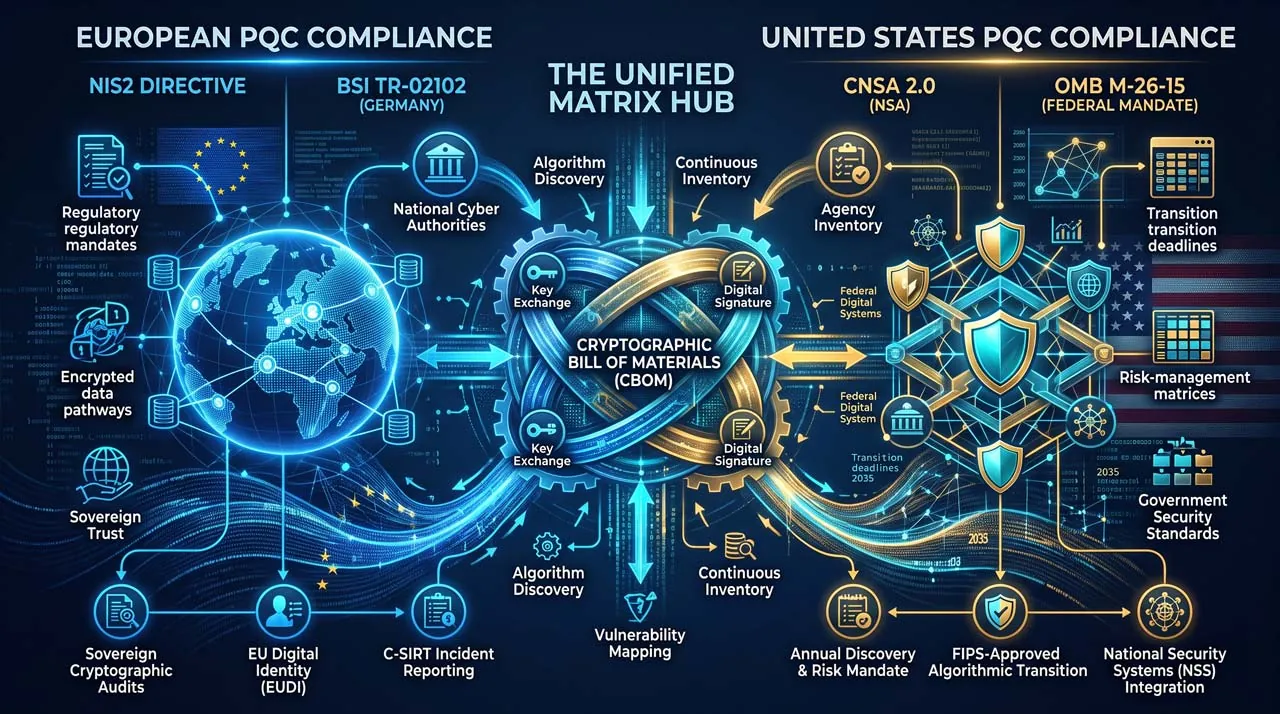
Germany just turned the EU’s post-quantum roadmap into law with teeth — and most US security leaders haven’t noticed.
On October 12, Germany’s Interior Ministry (BMI), Digital Ministry (BMDS), and BSI jointly published a national PQC migration guideline implementing the EU’s Coordinated Roadmap. Three things set it apart from the usual advisory memo:
The clock starts now. By December 31, 2026, organizations need a completed cryptographic inventory, assigned ownership, and a binding migration plan. High-risk systems must run quantum-safe crypto by end-2030; the broader transition wraps by 2035.
It’s not just guidance. Section 30 of Germany’s BSI Act — its NIS2 implementation — requires essential and important entities to keep cryptography at “state of the art” as a matter of statutory risk management. Telecom, energy, and DORA-covered financial firms follow sector-specific rules instead, but most other regulated entities are in scope.
The technical bar is specific. BSI’s TR-02102 guidance deprecates classical-only key agreement after 2031 (2030 for the most sensitive systems) and classical-only signatures after 2035, with hybrid classical+PQ schemes as the recommended bridge — and it names CycloneDX as the expected CBOM format.
Bottom line: US CISOs now face two overlapping clocks — CNSA 2.0/OMB M-26-15 at home, NIS2/BSI abroad — built on nearly identical scaffolding: inventory first, hybrid migration, full cutover. Map your crypto estate once against both frameworks, and you’ve covered the hard part twice over.
Is your organization tracking EU post-quantum obligations alongside US mandates, or still treating them as two separate problems?
Qubit Guard’s QuantVision engine builds that inventory once — discovering cryptography across code, network traffic, and infrastructure, then mapping it against CNSA 2.0, FIPS 140-3/203/204/205, and now NIS2/BSI TR-02102 — so one CBOM answers every regulator.
#PostQuantumCryptography #PQC #NIS2 #CNSA2 #CISO #CryptoAgility #Cybersecurity #FIPS140 #RiskManagement #QuantumSafe