

As organizations brace for the Post-Quantum Cryptography (PQC) transition mandated by NIST and global compliance frameworks, one foundational task stands in every CISO’s way: Building a complete Cryptographic Bill of Materials (CBOM).
You cannot migrate what you cannot see. But if your enterprise relies on traditional tools for cryptographic discovery, you are likely operating with massive blind spots.
Most commercial PQC discovery tools fall into standard silos:
- Network-Centric Scanners (like traditional Certificate Lifecycle Management tools) focus primarily on active TLS/SSL endpoints and certificates.
- Code-Centric Scanners (like standard SAST or IDE plug-ins) scan source code repositories for cryptographic API calls.
Here is why those single-dimension approaches fail—and why QuantVision by Qubit Guard was engineered to deliver true, full-stack cryptographic visibility.
The “100% Cryptographic Discovery” Fallacy
To achieve true PQC readiness, an inventory cannot just look at certificates or static code repositories. Cryptography lives everywhere across your hybrid tech stack:
When vendors claim “complete discovery,” they are often looking through a single lens. A network scanner cannot detect a hardcoded key inside a microservice. A static code analyzer cannot tell you if an unencrypted Redis protocol is transmitting data in cleartext across your production environment.
How QuantVision Outperforms the Market
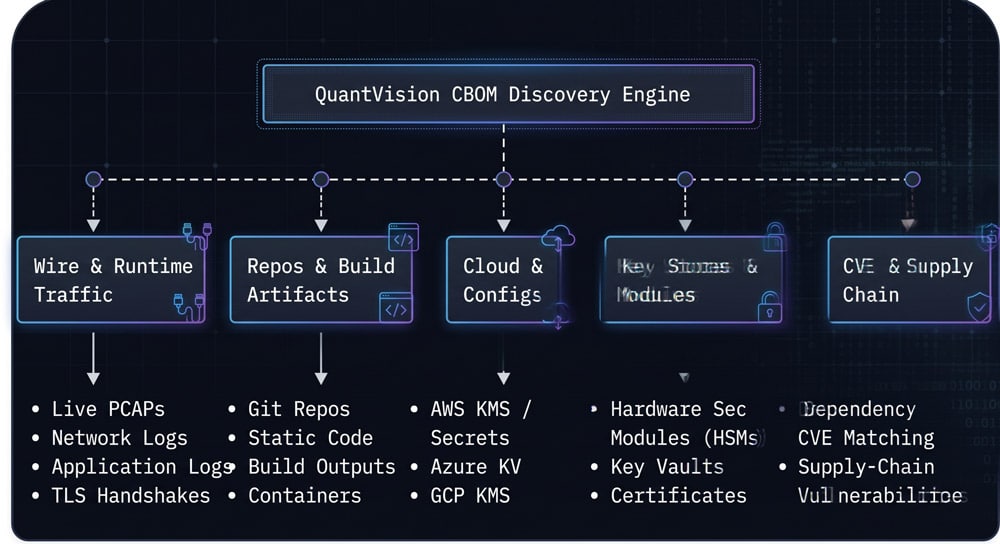
At Qubit Guard, we built QuantVision to ingest data across 7 distinct discovery layers into a single, automated CBOM engine:
- Multi-Vector Ingestion (Live Network, Code, Cloud, & HSMs)
While competitors require you to stitch together disparate point solutions, QuantVision unifies discovery across:
- 🌐 PCAP & Wire Traffic: Captures active cipher suites, TLS/SSH sessions, and unencrypted database wire connections (PostgreSQL, MySQL, Redis, MongoDB).
- 📜 Network & Application Logs: Inspects execution logs to detect dynamic algorithm invocations in production.
- 💻 Git & Code Repositories: Performs deep static code analysis (SAST) to identify hardcoded secrets, custom algorithms, and deprecated primitives (MD5, SHA-1, DES, DSA).
- 📦 Build Artifacts & Containers: Parses compiled binaries, package manifests, and container layers to track embedded third-party crypto libraries.
- ☁️ Cloud Infrastructure (AWS, Azure, GCP): Maps cloud-native key management services (AWS KMS, Azure Key Vault, GCP KMS) and infrastructure-as-code policies.
- 🔐 Hardware Security Modules (HSMs) & PKI: Connects to physical HSMs and enterprise CAs to track hardware-backed key material and certificate lifetimes.
- 🛡️ Third-Party CVE Matching: Correlates your inventory against live threat feeds to flag known vulnerabilities (e.g., CVE-2024-26130 in Python’s cryptography package) alongside post-quantum risks.
- Actionable Post-Quantum Taxonomy
Standard tools dump raw, overwhelming lists of algorithms. QuantVision categorizes every asset using a clear, four-tier quantum threat taxonomy aligned with NIST FIPS 203 (ML-KEM), FIPS 204 (ML-DSA), and FIPS 205 (SLH-DSA):
- 🔴 Priority 1 (Classical Breaks): Broken today (MD5, SHA-1, hardcoded keys)—immediate remediation required.
- 🟠 Priority 2 (Harvest-Now-Decrypt-Later): Broken at Q-Day by Shor’s algorithm (RSA, ECDSA, ECDHE, X25519).
- 🟡 Priority 3 Quantum Hardening & Long-Term Optimization: Effective key size halved (AES-128)—upgrade plan needed.
Quantum Threat Basis: Grover’s Algorithm (Quadratic Speedup)
- Current Status: Operationally Safe. Algorithms like AES-128 and SHA-256 remain secure against classical and near-term quantum attacks.
- Risk Focus: Grover’s algorithm theoretically reduces effective key search complexity from 2^{128} to 2^{64}. While 2^{64} serial quantum operations remain computationally infeasible for near-term QPUs, long-term standards (e.g., NSA CNSA 2.0) recommend migrating to 256-bit equivalents to maintain a full 128-bit quantum security margin.
- 🟢 Priority 4 (Quantum-Resistant): Adequate post-Q-Day security margin (AES-256, ML-KEM, ML-DSA).
- Native Policy & Compliance Mapping
A raw list is useless without regulatory context. QuantVision automatically evaluates your CBOM against major frameworks (FIPS 140-3, PCI-DSS, NSA CNSA 2.0, SEBI-CSCRF) using Open Policy Agent (OPA) rules—showing you exact violations in real time.
The Bottom Line
A Cryptographic Bill of Materials (CBOM) shouldn’t be a static spreadsheet or an incomplete snapshot from a single certificate scanner. It needs to be an active, multi-modal inventory that captures how cryptography is built, deployed, and executed across your entire digital footprint.
Whether you are preparing for PQC readiness audits, securing your software supply chain, or eliminating legacy cryptographic debt, QuantVision gives you the clarity needed to migrate with confidence.
💬 How is your organization approaching multi-source CBOM discovery for the post-quantum transition? Let’s discuss in the comments below.
👇 Learn more about full-stack PQC readiness at Qubit Guard.