

In the movie Interstellar, humanity faces a quiet, existential countdown. The planet is running out of time, and the only way to save civilization is to solve a seemingly impossible mathematical puzzle.
The catch? The equations they are using on Earth are incomplete. To unlock the future, they need “quantum data” insights that can only be found by looking directly inside the singularity.
Right now, the cybersecurity world is living out its own Interstellar plotline. We are racing against a ticking clock known as Y2Q, the point where quantum computers become powerful enough to shatter the public-key cryptography (like RSA and ECC) that secures 99% of global digital infrastructure.
But modern threat actors aren’t waiting for the countdown to hit zero. They are weaponizing the quantum transition right now through two devastating vectors:
📉 1. The Slow Burn: HNDL (Harvest Now, Decrypt Later) Like the crop blight slowly suffocating Earth over decades, HNDL is a passive, long-term threat. Adversaries are actively intercepting and storing encrypted enterprise data today. They don’t care that they can’t read it yet they are simply waiting for a cryptanalytically relevant quantum computer (CRQC) to turn on so they can decrypt your intellectual property down the road.
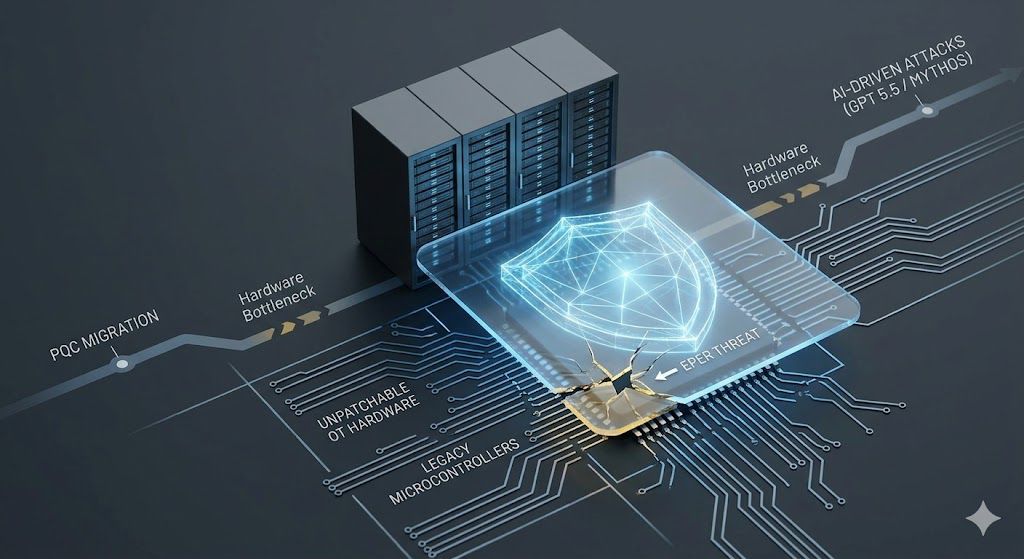
💥 2. The Immediate Strike: EPER (Encrypt with PQC, Enforce Ransom) If HNDL is the slow blight, EPER is an immediate catastrophic event. Rogue threat groups aren’t waiting for a quantum computer to be built; they are using post-quantum cryptographic math right now as a weapon. By deploying ransomware built on unbreakable, next-gen PQC algorithms against legacy enterprises, they create an instant operational blackout. If your defenses aren’t agile enough to handle or recognize PQC-mutated malware, you are locked out with a key that classical recovery tools cannot duplicate.
Just like Professor Brand’s incomplete equations, our legacy encryption methods simply aren’t built to survive this new environment. We cannot just build “bigger firewalls” (just like NASA couldn’t just build bigger chemical rockets). We have to completely rewrite the underlying math by transitioning to crypto-agile architectures and the new NIST PQC standards.
In the film, Cooper reminds us: “The only way humans have ever figured out how to get anywhere is to leave something behind.”
To move safely into the quantum era, organizations must be willing to leave legacy cryptographic assumptions behind. Continuous discovery, automated inventory, and architectural crypto-agility aren’t steps we can delay—they are the staging area for data survival.
Is your organization still trying to build bigger chemical rockets, or are you actively rewriting the math to defend against both today’s and tomorrow’s threats?
hashtag#PostQuantumCryptography hashtag#Cybersecurity hashtag#QuantumComputing hashtag
What “Interstellar” Teaches Us About the Post-Quantum Cryptography Race
Qubit Guard messenger is helping businesses and larger networks that manage huge user base by providing a clear structure of conversations
Qubit Guard messenger is helping businesses and larger networks that manage huge user base by providing a clear structure of conversations
- White Labeling
- App Customization
- Secured Communication